Guide
Campervan water system: fresh water, grey water and the right tank size
Water is the heaviest thing you carry in a campervan: 100 litres weigh 100 kilograms. A tank that is too small sends you to a service point every other day; one that is too big eats payload and space. Here you work out your consumption, choose tank sizes and plan the pump, pipes and frost protection.
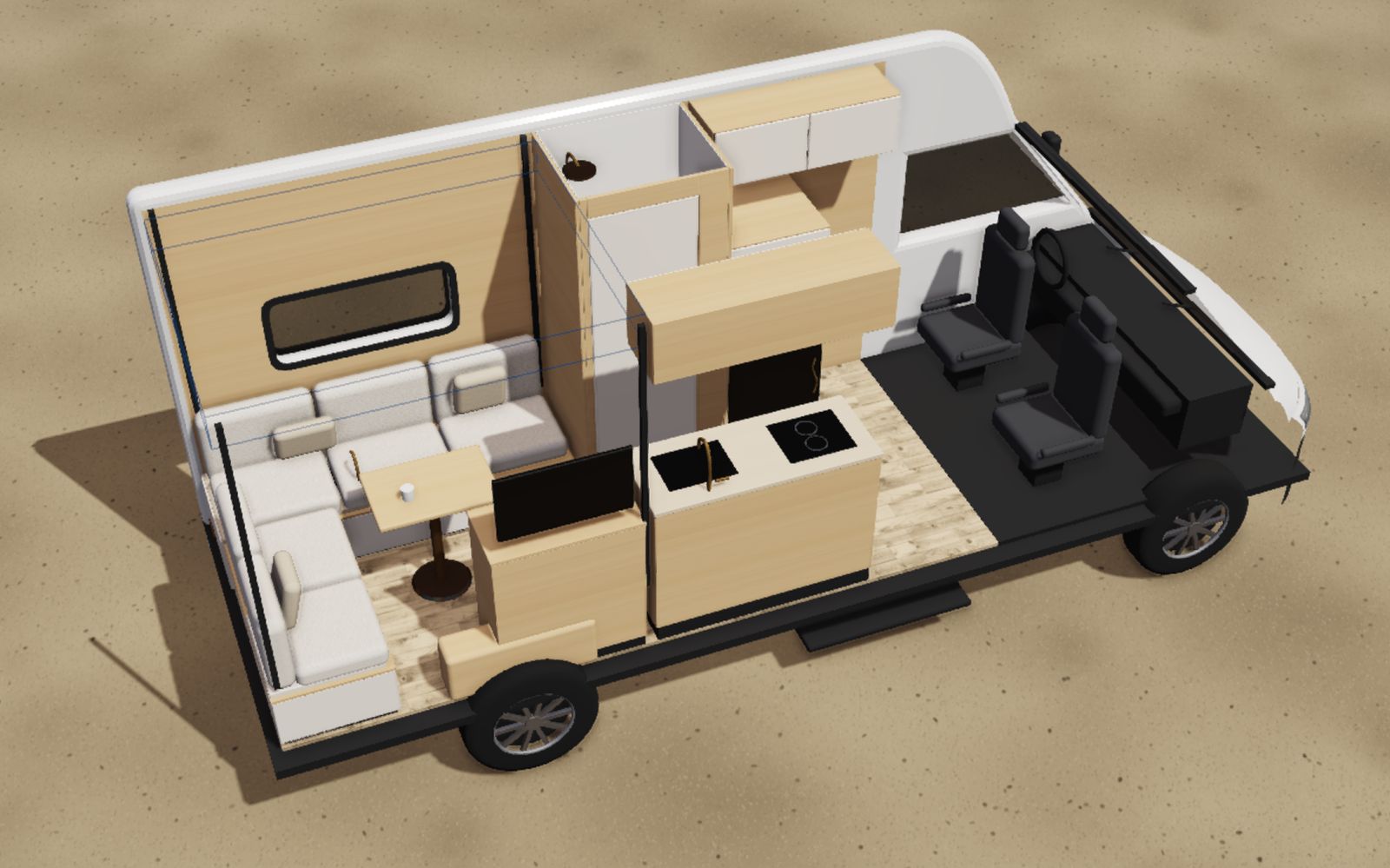
A campervan water system has only a few parts: fresh water tank, pump, pipes, a tap and perhaps a shower, plus a grey water tank for waste water from the sink and shower. The toilet is a separate system. The most important decision is tank size, and that depends almost entirely on how much you use and how often you can refill.
How much water you use per day
In a van you use far less water than at home, because every litre has to be carried and then disposed of. These rules of thumb per person per day help with the estimate:
| Use | frugal | comfortable |
|---|---|---|
| Drinking (if from the tank) | 2 l | 3 l |
| Cooking | 1 l | 2 l |
| Washing up | 3 l | 5 l |
| Brushing teeth, washing hands and face | 2 l | 4 l |
| Short shower in the van | – | 10 l |
| Total per person per day | about 8 l | about 24 l |
The shower makes the biggest difference. If you shower on campsites, at the pool or with an outdoor shower, 8 to 12 litres per person per day is usually plenty. If you shower in the van every day, you need several times that. Measure your own use on a short test trip; it is more accurate than any table.
Step by step to the right tank size
Fresh water tank (litres) = people × use per person per day × days between refills × 1.1
The factor 1.1 is a 10 % reserve, because the pump never empties the tank completely and you do not want to plan around the last litre. Worked through for a couple who live frugally and refill every three days:
- Use: 12 litres per person per day, frugal with a little headroom.
- Two people: 2 × 12 = 24 litres a day.
- Three days to the next tap: 24 × 3 = 72 litres.
- 10 % reserve: 72 × 1.1 ≈ 79 litres. Choice: about 80 litres of fresh water.
If the same couple want a daily shower in the van, demand rises by 20 litres a day. For three days that means (24 + 20) × 3 × 1.1 ≈ 145 litres of tank volume. For many panel vans that is too much space and weight. It is often more sensible to refill more often or shower elsewhere.
Grey water and toilet
Almost everything that comes out of the fresh water tank ends up back in the van as grey water: washing up, teeth, showers. Only drinking and cooking water is missing. As a rule of thumb the grey water tank should be at least three quarters the size of the fresh water tank. If you shower in the van, make it the same size. In the example that means 60 to 80 litres.
- Grey water starts to smell after a few warm days. A trap under the sink and regular emptying help.
- Only empty it at a proper disposal point, never into nature or a road drain.
- A wide drain outlet clogs less easily.
For the toilet there are three common types: the cassette toilet with a sanitary additive, the separating toilet with its own urine container, and the portable toilet. With a separating toilet the urine container sets the limit: allow roughly 1 to 2 litres per person per day, and plan how often you can empty it.
Fitting tanks, pump and pipes
- Tanks low and between the axles: water is heavy and sloshes about. Low and central improves stability and spares the axle loads.
- Inside or underslung: a tank inside is protected from frost but takes storage space. An underslung tank saves space but needs insulation and heating in winter.
- Materials suitable for drinking water: tank, hoses and fittings must be food-safe.
- Pump: a pressure pump with a pressure switch supplies several taps evenly. An accumulator tank stops it switching on and off constantly. A filter in front of the pump keeps dirt out.
- Draining: every tank and every pipe needs a lowest point with a drain, or water stays in the system.
- Hot water: a water heater is usually warmed by the space heater, by gas or by 230 V. Gas appliances and 230 V connections must be fitted and checked by a qualified professional.
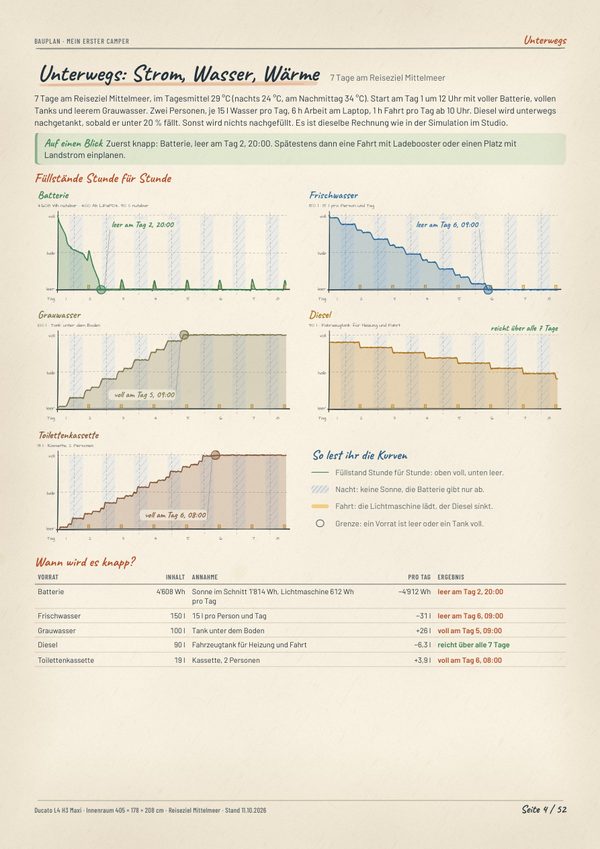
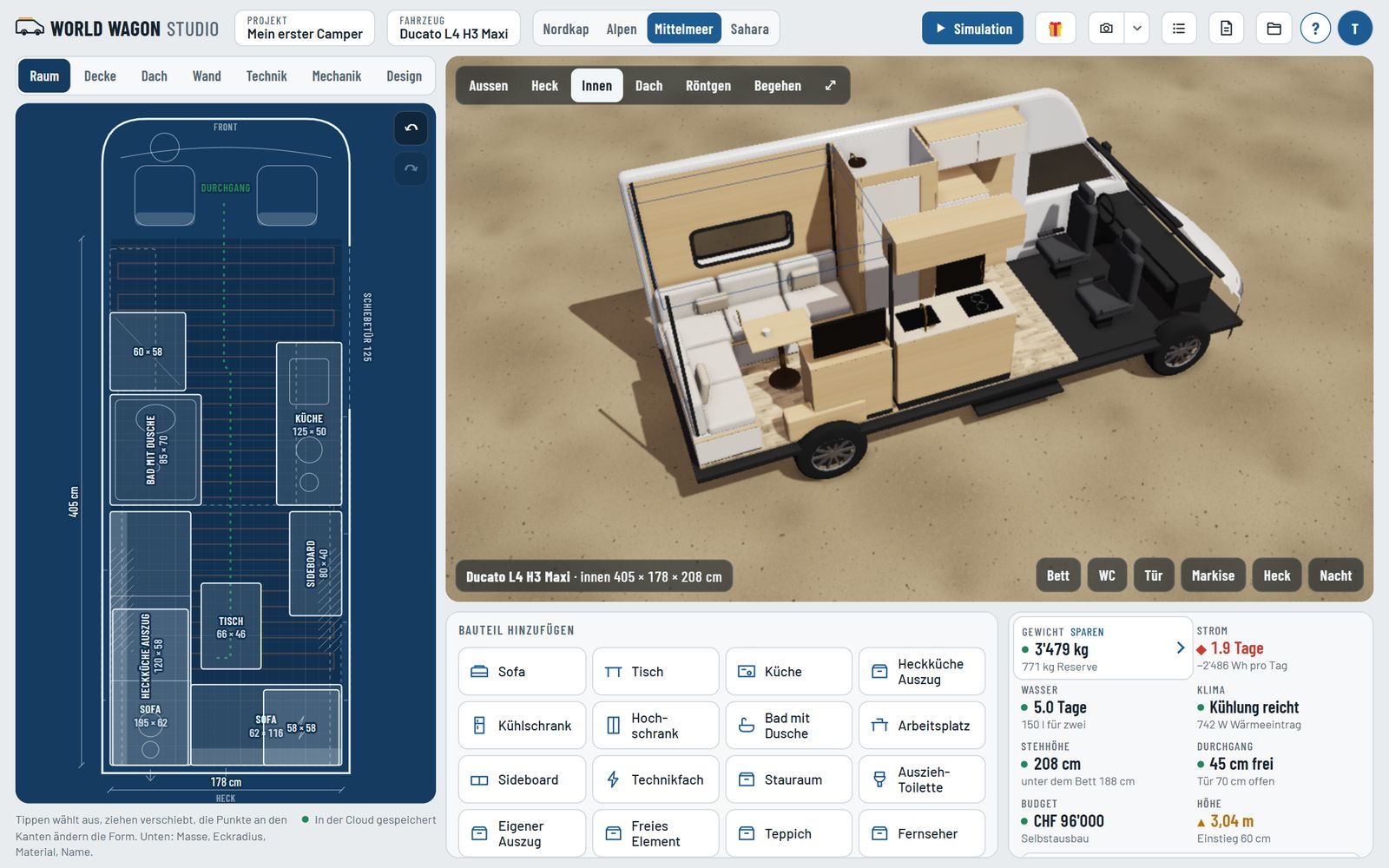
In the studio the simulation tracks fresh water, grey water and toilet hour by hour over 3, 7 or 14 days. That shows you whether 80 litres will last your trip before you buy the tank.
Hygiene and frost protection
Standing water in a warm tank is a good breeding ground for germs. So only fill up with drinking water from safe sources, use it fairly quickly and leave the tank empty and open to dry when the van is parked for a while. Clean tank and pipes regularly with a product intended for drinking water systems. If in doubt, drink bottled water or boil it.
Water that freezes in pipes, the pump or the water heater can burst them. For winter trips:
- Run tanks and pipes through the heated area, not along the cold outer wall.
- Insulate and heat underslung tanks and the grey water outlet, or travel with them empty.
- In frost without heating, drain the whole system, including pump and water heater.
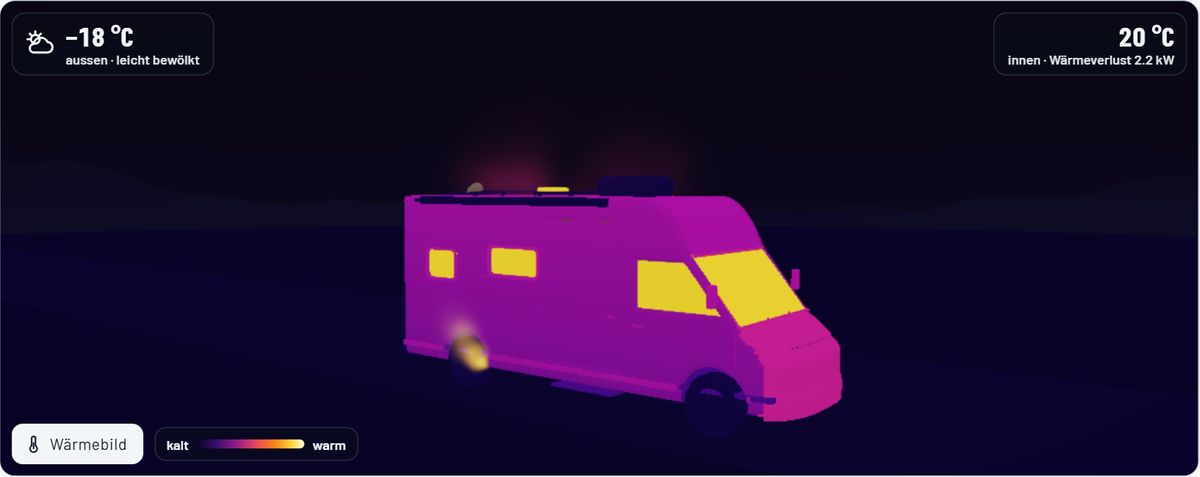
More on winter use in insulation and heating.
Common water system mistakes
- Leaving water out of the weight sums. 80 litres of water are 80 kg of payload. Put them into your weight budget.
- Grey water tank too small. Then the waste tank is full before the fresh water is used up.
- No lowest point for draining. Leftover water freezes in winter and goes off in summer.
- Tank behind the rear axle. That adds extra load to the rear axle and makes the van tail-heavy.
- No level gauge. Without one you only notice the empty tank in the shower.
Frequently asked questions
How much water do you use per day in a campervan?
As a rule of thumb about 8 to 12 litres per person per day if you are frugal and do not shower in the van. With a daily shower on board it is more like 20 to 25 litres.
What size fresh water tank do I need?
People times daily use times days between refills, plus a 10 % reserve. For two frugal people and three days that comes to about 80 litres.
How big should the grey water tank be?
At least three quarters of the fresh water tank, and the same size if you shower in the van. Otherwise the waste tank fills up before the fresh water runs out.
Can you drink water from a campervan tank?
Yes, if tank, hoses and fittings are food-safe, the water comes from a safe source and the system is cleaned regularly. If in doubt, use bottled water or boil it.
How do I protect the water system from frost?
Run tanks and pipes inside the heated living space, insulate and heat underslung tanks, and in frost without heating drain the whole system including pump and water heater.