Guide
Campervan weight and payload: keeping the 3.5-tonne limit under control
In many van builds, weight becomes the tightest constraint, tighter than space or budget. A converted panel van gets close to the 3.5-tonne limit quickly, and then there is no margin left for water, luggage and bikes. Here you learn how to find your real payload, draw up a weight budget and save weight where it actually counts.
Whether you can drive your van on a standard category B licence depends on its maximum authorised mass. In the UK, Switzerland and EU countries such as Germany and Austria, category B covers vehicles up to 3.5 t. Above that you usually need a different category, such as C1, and further rules may apply depending on the country. An overloaded van brakes worse, strains tyres and axles, and can lead to fines and trouble with your insurer.
The key terms
| Term | Meaning | Where to find it |
|---|---|---|
| Maximum authorised mass (gross vehicle weight) | the most the vehicle may weigh with everything in it | registration document, vehicle identification plate |
| Unladen weight | weight of the vehicle ready to drive; exactly what is included differs by country and document | vehicle documents, more reliably: a weighbridge |
| Payload | maximum authorised mass minus actual unladen weight | work it out yourself |
| Maximum axle load | the limit per axle, front and rear separately | vehicle documents, identification plate |
| Roof load | the maximum load on the roof, for example for solar, roof bars or a roof tent | vehicle handbook |
The figures in the documents are a starting point. A tow bar, optional extras or a larger fuel tank often make the real vehicle heavier. So the rule is: weigh, don’t guess.
Step 1: weigh the van
Public weighbridges are often found at quarries, recycling centres, agricultural suppliers or vehicle testing stations. Here is how to do it:
- Full fuel tank, no load, only the driver on board. Note who is in the vehicle.
- First drive just the front axle onto the scale: that is the front axle load.
- Then drive fully onto the scale: that is the total weight.
- Total weight minus front axle load gives the rear axle load.
- Repeat everything after the build, this time loaded and ready to travel.
The difference between the maximum authorised mass and your measured unladen weight is your budget for the build, water, passengers and luggage. If you weighed with the driver on board, do not count the driver again in the budget.
Step 2: draw up a weight budget
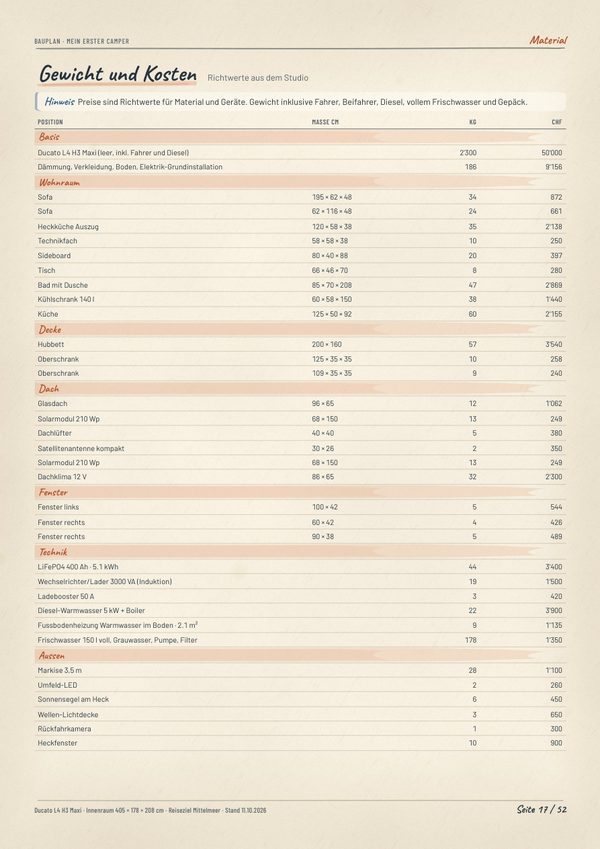
List every component with its weight, small items included. The example shows a large panel van, roughly 6 m long, with a high roof, converted for two people. All figures are rules of thumb for orientation, not the values of any particular vehicle.
| Item | Weight |
|---|---|
| Unladen weight from the weighbridge, with driver and full diesel tank | 2,450 kg |
| Floor, insulation, wall panelling | 90 kg |
| Furniture including bed and mattress | 180 kg |
| Windows, roof hatch, fan | 30 kg |
| Electrics: 200 Ah LiFePO4, 300 Wp solar with mounts, chargers, cables | 70 kg |
| Compressor fridge | 20 kg |
| Diesel heater with ducting and fuel line | 15 kg |
| Water system empty: tanks, pump, pipes | 20 kg |
| Fresh water, 80 litres | 80 kg |
| Toilet | 10 kg |
| Front passenger | 75 kg |
| Clothes, food, crockery, tools | 120 kg |
| Two bikes with rack | 45 kg |
| Total, ready to travel | 3,205 kg |
| Margin to 3,500 kg | 295 kg |
That looks like plenty of room, but it melts away quickly: an awning, a gas bottle, food for two weeks or a solid worktop. So plan a margin of at least 100 to 150 kg (rule of thumb), because screws, glue, cable ties and odds and ends never all make it onto the list.
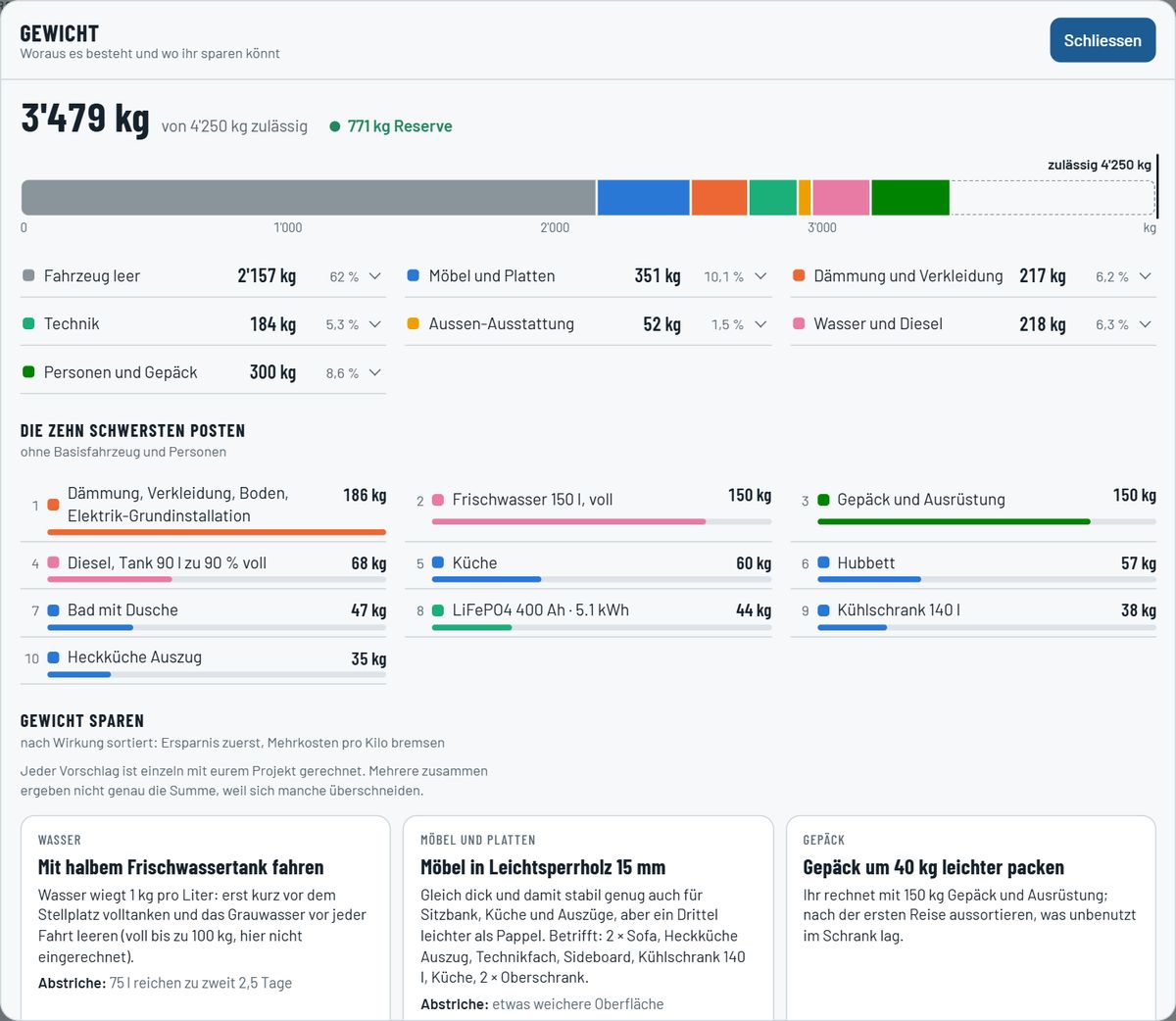
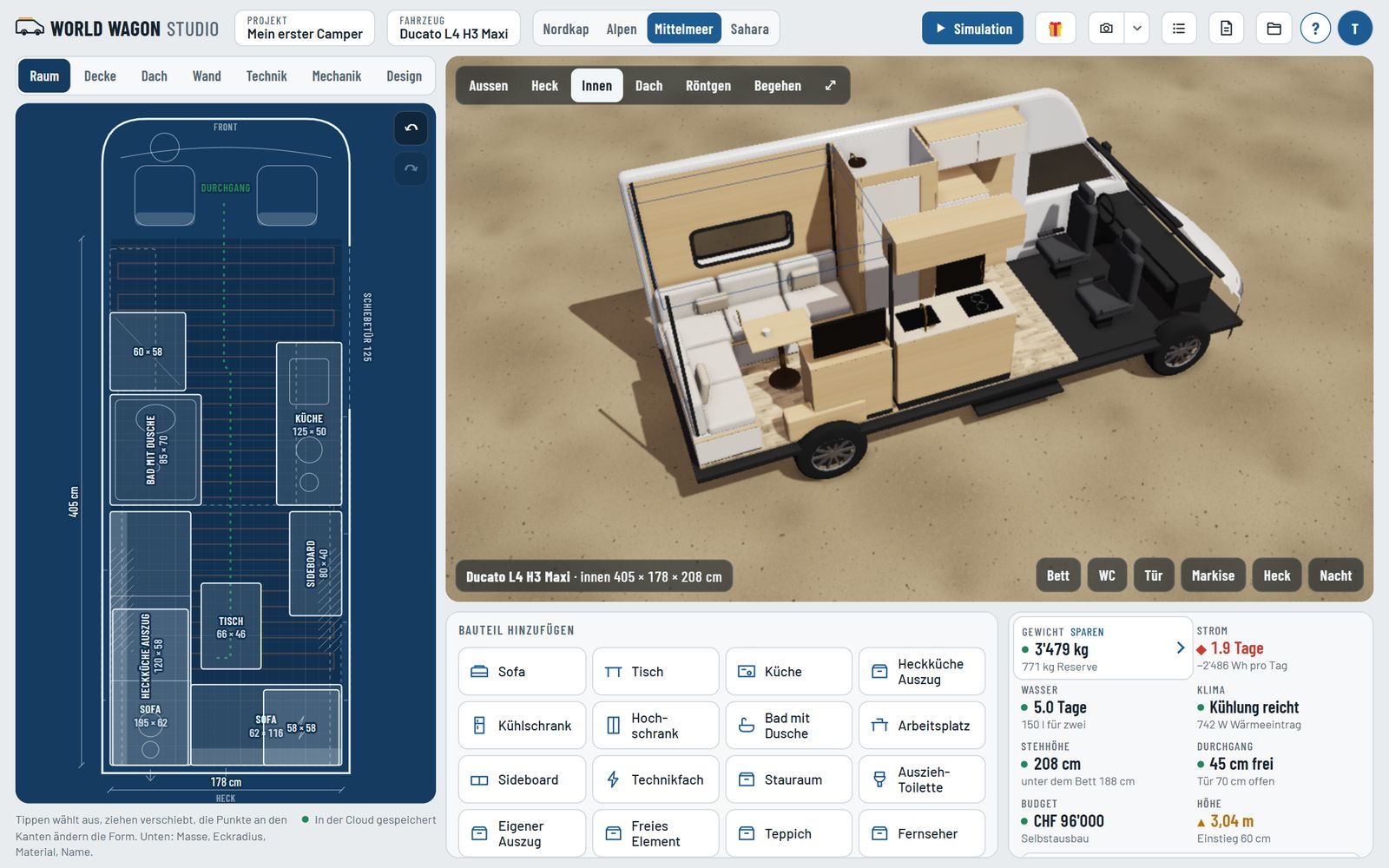
In the studio this budget grows automatically: every piece of furniture and every component brings its own weight, the board computer shows the total as you go, and the weight dialog suggests where you can save.
Step 3: check axle loads and centre of gravity
Even when the total weight is fine, a single axle can be overloaded. This happens mostly with a rear bed over a garage, water tanks behind the rear axle, bikes on the back and pickups with a cabin, where almost the entire build weight sits on the rear axle.
- Heavy items low and, where possible, between the axles: battery, water, fridge.
- Weight behind the rear axle acts like a lever: it loads the rear axle even more and takes load off the front.
- Balance left and right: do not put kitchen, tanks and battery all on the same side.
- Only put on the roof what has to be there. Solar is light; a roof tent with bars is not. While driving, the roof load limit in the vehicle handbook applies.
- Check the tyres: their load rating must match the axle load.
After the build, weigh each axle separately with the van loaded for travel. Only then do you know whether the distribution is right.
Saving weight where it counts
Not every gram counts equally. Large surfaces and heavy single items make the biggest difference. Sheet material for the furniture is a good example:
| Material, 15 mm thick | Density (rule of thumb) | Weight per m² |
|---|---|---|
| Poplar plywood | about 450 kg/m³ | about 6.8 kg |
| Birch plywood | about 680 kg/m³ | about 10.2 kg |
The calculation: weight per m² = thickness in m × density. For 15 mm poplar that is 0.015 × 450 ≈ 6.8 kg. With 10 m² of sheet material for kitchen, bed and cupboards, you save about 35 kg compared with birch.
- LiFePO4 instead of AGM: usually less than half the weight for the same usable energy. More in campervan electrical system.
- Travel with little water: fill up near your overnight spot and empty the grey water before you set off. How much you really need is covered in campervan water system.
- No heavy worktops: stone or solid hardwood weighs several times as much as light plywood.
- Declutter your kit: otherwise the toolbox, a second set of crockery and two weeks of food travel with you every time.
Common mistakes and a checklist
- Working with the unladen weight from the paperwork. Equipment and accessories often make the real van heavier.
- Weighing only after the build. By then it is too late to switch to lighter materials.
- Forgetting people, water and food. Together they easily add up to 200 kg or more.
- Checking only the total weight. The rear axle often reaches its limit first.
- Counting on an upgrade to rescue you. Not every vehicle can be re-plated to a higher weight, and above 3.5 t you usually need a different licence category.
Checklist:
- Maximum authorised mass, axle loads and roof load noted from documents and handbook
- Unladen weight and axle loads measured on a weighbridge
- Weight budget including all components, people, water and luggage
- Margin of at least 100 to 150 kg
- Weighed again after the build, ready to travel, axle by axle
Frequently asked questions
How much payload does a converted panel van have?
That depends heavily on the vehicle and the build. With a large panel van at 3.5 t, often only a few hundred kilograms are left after the build for people, water and luggage. You only know for sure after weighing.
What counts towards payload?
Everything that is not in the measured unladen weight: the build, passengers, water, gas, food, clothes, bikes, awning and accessories. Small things like tools and camping chairs add up too.
Can I drive a campervan over 3.5 t on a car licence?
In the UK, Switzerland and EU countries such as Germany and Austria, category B generally covers vehicles up to 3.5 t only. Older licences and special rules may allow more, so check your licence and ask your licensing or road traffic authority.
What happens if my campervan is overweight?
Braking distance and tyre load increase and handling gets worse. At roadside checks you may face fines and be stopped from driving on, depending on the country, and after an accident there can be problems with your insurer.
Where can I weigh my campervan?
On a public weighbridge, for example at quarries, recycling centres or agricultural suppliers. Weigh the front axle on its own first, then the whole vehicle, and you also get the rear axle load.