Guide
Campervan electrical system: how to size battery, solar and cables
How big does the battery need to be, how much solar does the roof need and how thick should the cables be? Four simple calculations take you from your daily consumption to an electrical system that still keeps the lights on after two grey days. All figures are rules of thumb, and you can redo every step with your own appliances.
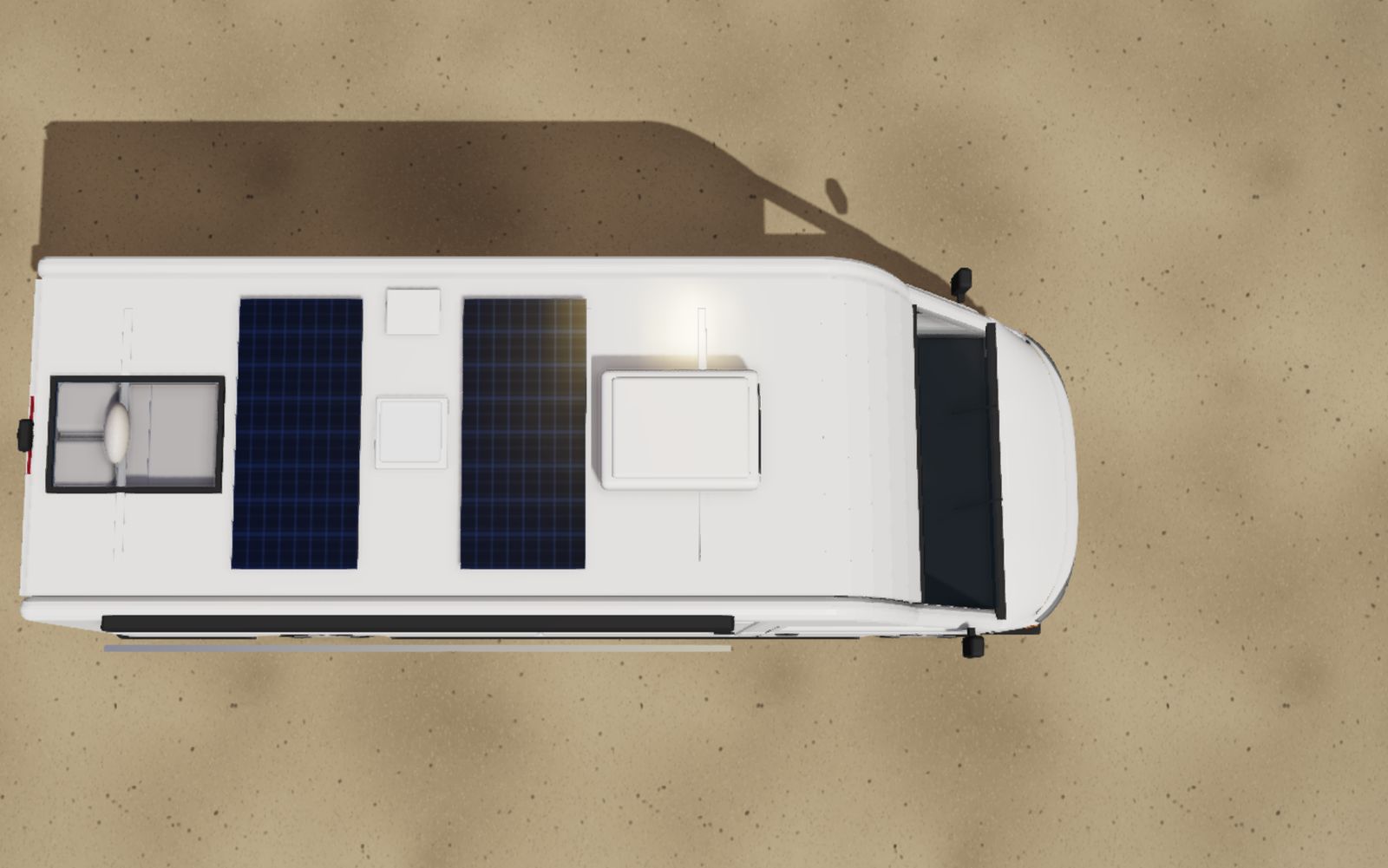
A campervan’s on-board electrics almost always run on 12 V. A leisure battery stores the energy; solar panels, the alternator and, when needed, a mains charger on hook-up top it up again. To make the books balance, work in a fixed order: consumption first, then storage, then charging. Where the electrics fit into the wider project is covered in plan a camper van build.
Watts, watt-hours and amp-hours
- Watts (W) are the power an appliance draws at a given moment, for example 45 W for a running compressor fridge.
- Watt-hours (Wh) are energy over time: 45 W for 8 hours is 360 Wh.
- Amp-hours (Ah) are the usual battery rating. To convert: Wh = Ah × voltage. A 100 Ah battery at 12.8 V stores about 1,280 Wh.
Work in Wh wherever you can. That way you can compare 12 V and 230 V appliances without getting in a muddle.
Step 1: work out your daily consumption
List every appliance with its power and daily running time. You will find the power on the rating plate or in the data sheet. For the fridge, do not multiply the rated power by 24 hours; count the time the compressor actually runs. In summer that is a lot more than in spring.
| Appliance | Power | Hours per day | Energy per day |
|---|---|---|---|
| Compressor fridge | 45 W | 8 h, spread over the day | 360 Wh |
| LED lighting | 10 W | 4 h | 40 Wh |
| Roof fan | 15 W | 6 h | 90 Wh |
| Water pump | 48 W | 0.25 h | 12 Wh |
| Laptop | 60 W | 2 h | 120 Wh |
| Charging phones and small devices | – | – | 30 Wh |
| Total | 652 Wh |
In winter, extra loads appear: a diesel air heater needs electricity for its fan and fuel pump, roughly 100 to 300 Wh a day depending on the model and running time (rule of thumb). At the same time the solar roof delivers far less. So calculate two scenarios, one for summer and one for winter.
Step 2: size the battery
The battery has to bridge the days when there is little or no charging. The formula:
Battery (Wh) = daily use × reserve factor × days without charging ÷ usable share of capacity
Worked through with the example above:
- Daily use: 652 Wh, rounded to 650 Wh.
- Reserve factor 1.2 for cable and converter losses and the unexpected: 650 × 1.2 = 780 Wh.
- Two days without meaningful charging: 780 × 2 = 1,560 Wh.
- LiFePO4 with 80 % usable capacity: 1,560 ÷ 0.8 = 1,950 Wh.
- Convert at 12.8 V: 1,950 ÷ 12.8 ≈ 152 Ah. Choice: 150 to 200 Ah LiFePO4.
An AGM battery should only be discharged to about half, or it ages quickly. The same calculation then gives 1,560 ÷ 0.5 ÷ 12 V = 260 Ah, so far more rated capacity and several times the weight.
| Property | LiFePO4 | AGM |
|---|---|---|
| Usable capacity (rule of thumb) | 80 to 90 % | about 50 % |
| Weight per 100 Ah (rule of thumb) | about 10 to 13 kg | about 25 to 30 kg |
| Service life | usually several thousand cycles | usually a few hundred cycles |
| Charging in frost | do not charge below 0 °C; fit it in the heated living space or choose a battery with built-in heating | possible, but slower |
| Purchase price | higher | lower |
Step 3: solar and other charging
Solar panels are rated in watts peak (Wp), their output under standard laboratory conditions. On a van roof the panels lie flat, get hot and are sometimes shaded. So calculate conservatively:
Solar (Wp) = daily use including reserve ÷ (peak sun hours × 0.7)
Peak sun hours are the number of hours in which a panel would, in effect, deliver its full rated output. The factor 0.7 covers losses from heat, flat mounting, the charge controller and cables. For flat-mounted panels these rough values apply:
| Season and region | Peak sun hours per day (rule of thumb) |
|---|---|
| Summer, central Europe | about 4 |
| Summer, Mediterranean | about 5 to 6 |
| Spring and autumn, central Europe | about 2 to 3 |
| Winter, central Europe | under 1 |
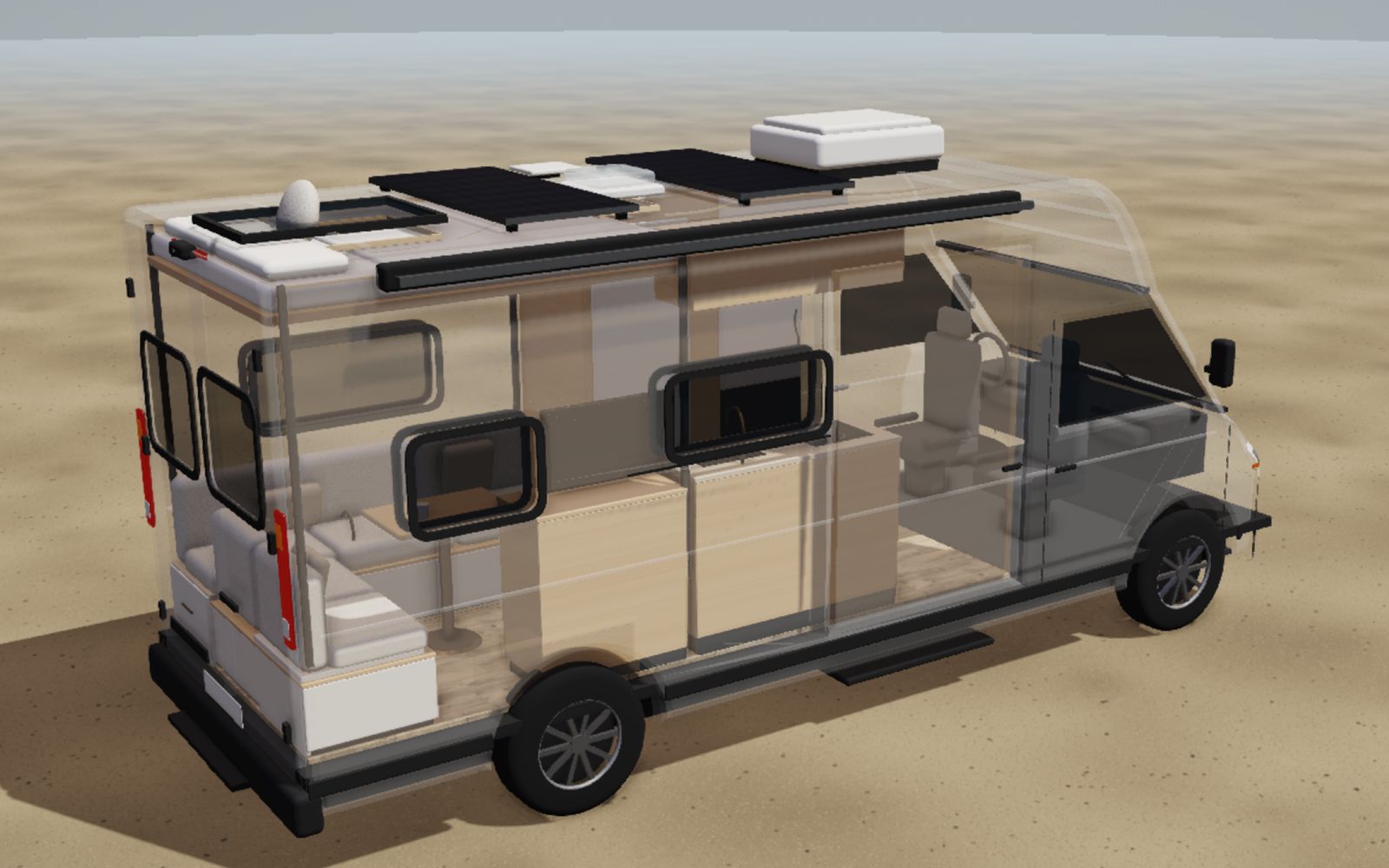
In the example: 780 Wh ÷ (4 × 0.7) ≈ 279 Wp, so you choose about 300 Wp. For roof space, allow roughly 180 to 200 Wp per square metre of panel area (rule of thumb). Plan the panels together with the roof hatch and fan so that nothing shades anything else.
In winter the same 300 Wp only yields about 300 × 0.7 × 0.7 ≈ 150 Wh a day. That is not enough. This is where a DC-DC charger (often called a battery-to-battery charger) helps: it charges from the alternator while you drive. A 30 A unit adds roughly 350 to 400 Wh per hour of driving. On a campsite, a mains charger on electric hook-up does the job.
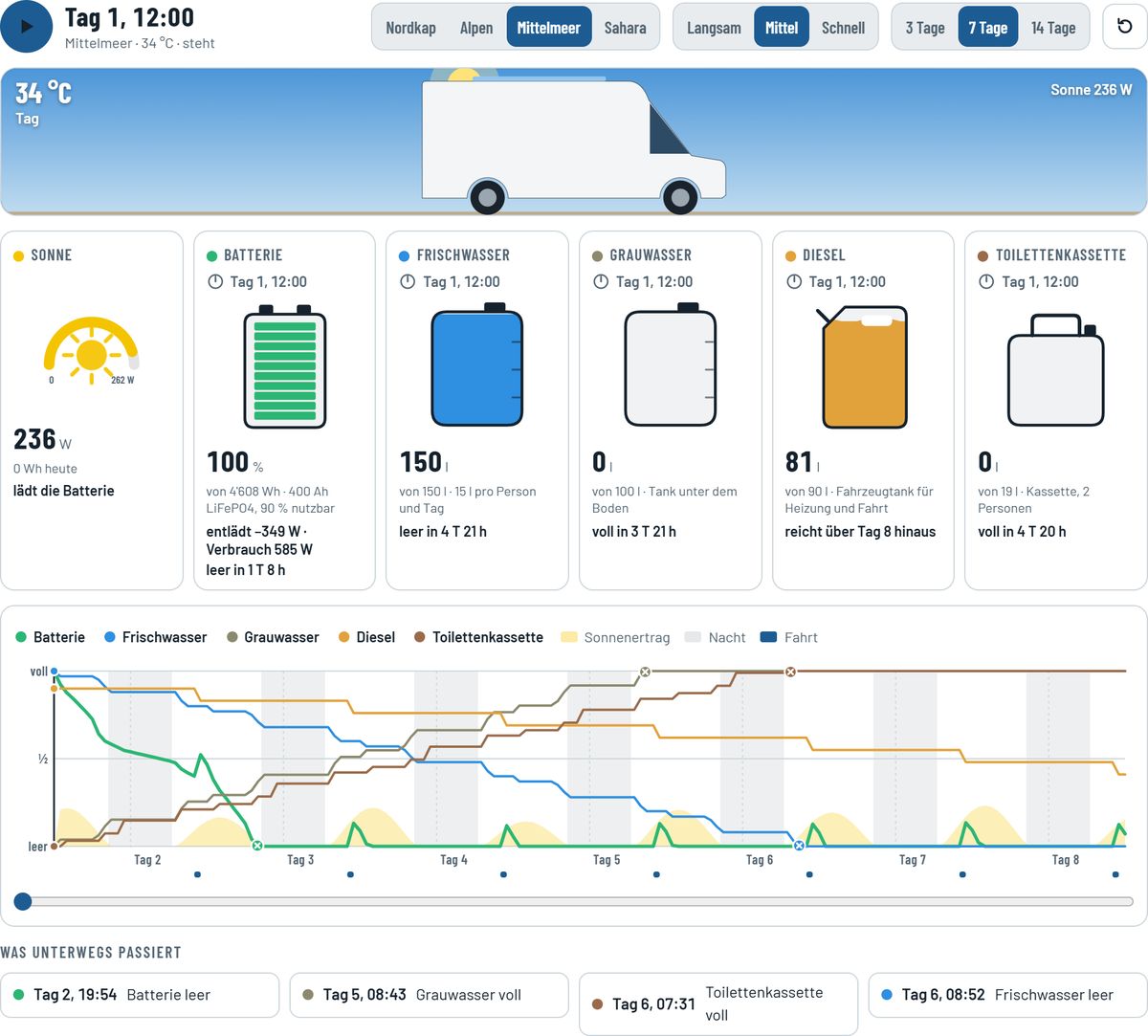
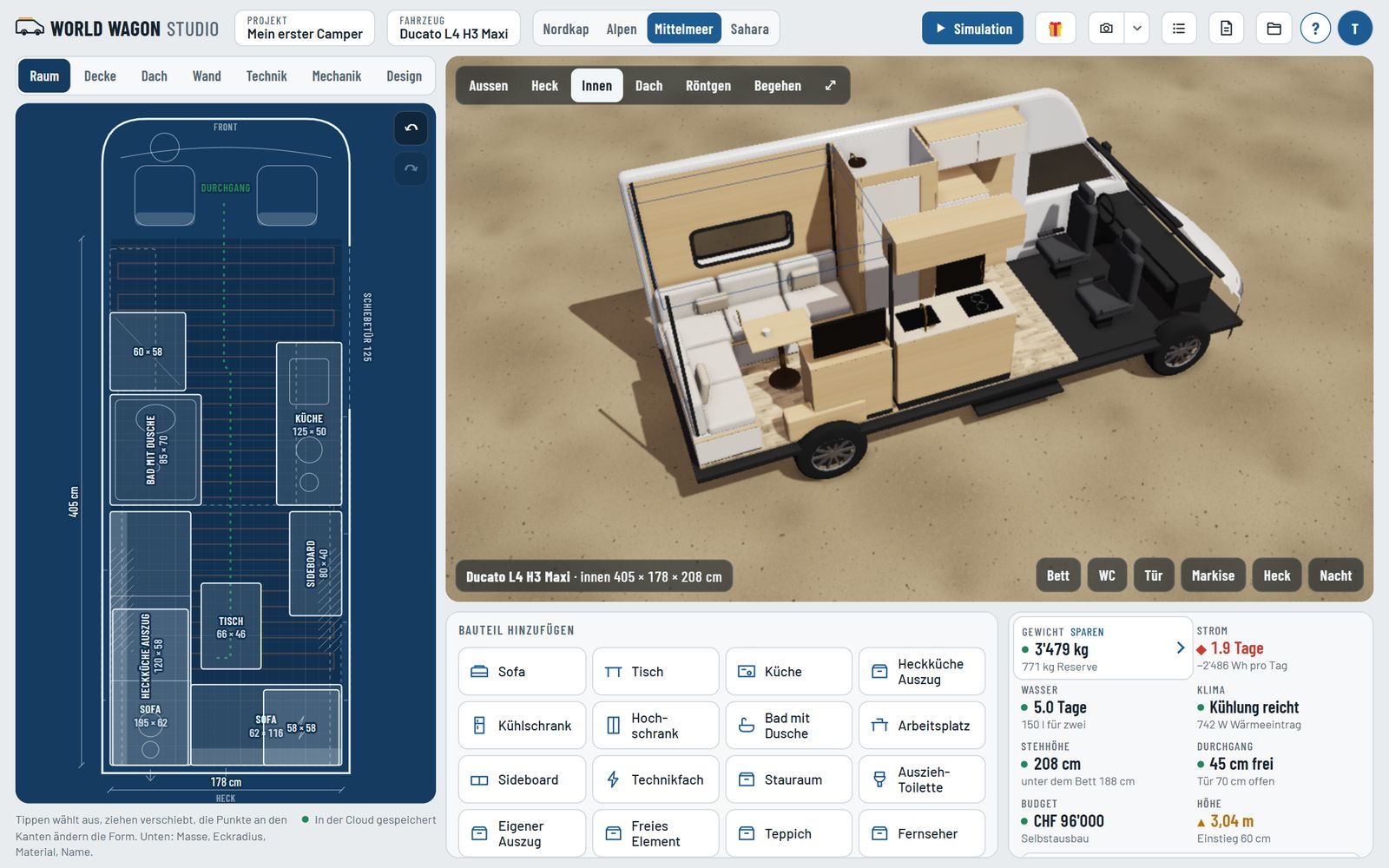
A calculation based on daily averages will not tell you whether the battery is flat after three cloudy days in the Alps. In the studio you can simulate battery and solar hour by hour over 3, 7 or 14 days, for destinations from the North Cape to the Sahara.
Step 4: cable size and fuses
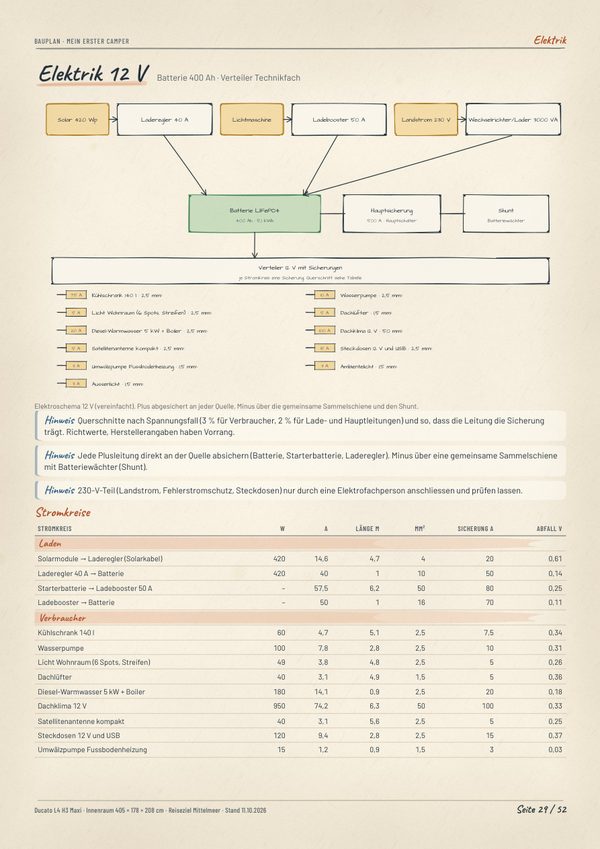
At 12 V the currents are high, and every metre of cable costs voltage. As a rule of thumb, keep the voltage drop below 3 %, which at 12 V means below about 0.36 V. Work out the minimum cross-section for copper cable like this:
Cross-section (mm²) = 2 × one-way cable length (m) × current (A) ÷ (56 × permitted voltage drop in V)
The 2 accounts for the positive and negative conductors; 56 is the conductivity of copper. Fridge example: 45 W ÷ 12 V ≈ 4 A, cable run 4 m. So 2 × 4 × 4 ÷ (56 × 0.36) ≈ 1.6 mm², and you choose 2.5 mm². If the manufacturer asks for more, follow the manufacturer.
- Every circuit gets a fuse close to the battery, rated to match the cable. The fuse protects the cable, not the appliance.
- For high currents, for example to an inverter or a DC-DC charger, the current rating of the cable matters as well. Follow the appliance manufacturer’s instructions.
- Make positive and negative the same size and keep runs as short as possible.
Common mistakes with campervan electrics
- Mixing up watts and watt-hours. A 45 W fridge does not use 45 Wh a day, but many times that.
- Sizing solar for midsummer only. In autumn and winter the yield drops sharply.
- Leaving the inverter switched on all the time. Even with no load it draws a few watts depending on the model, and over 24 hours that adds up.
- Planning for big 230 V appliances. A hairdryer, kettle or induction hob running through an inverter pulls well over 100 A from the 12 V battery.
- Cables too thin and no main fuse. That wastes power and is a fire risk.
- Fitting a LiFePO4 battery somewhere cold. It must not be charged below 0 °C.
How insulation and heating affect your winter consumption is explained in insulation and heating. The weight of battery and solar belongs in your weight budget.
Frequently asked questions
How big a leisure battery do I need in a campervan?
Multiply daily use in Wh by a reserve factor and by the days without charging, then divide by the usable share of capacity. In the example with fridge, lights, fan and laptop that comes to about 150 Ah of LiFePO4, so 150 to 200 Ah is a sensible choice.
How many watts of solar do I need on a campervan?
Divide your daily use including reserve by peak sun hours times 0.7. For 780 Wh a day in a central European summer that gives about 300 Wp.
Is solar enough in winter?
Usually not. Flat-mounted panels deliver only a fraction of their summer yield in a central European winter. A DC-DC charger that charges while you drive and hook-up on campsites close the gap.
LiFePO4 or AGM?
LiFePO4 costs more but is much lighter, can be discharged more deeply and lasts more cycles. AGM is cheaper and simpler in frost, but for the same usable energy it weighs several times as much.
Do I need an inverter?
Only if you want to run 230 V appliances that are not available in a 12 V version. Fridge, lights, fan and many chargers run directly on 12 V, which avoids conversion losses.