Guide
Campervan insulation and heating: getting your van ready for winter
Winter shows how well a conversion has been planned. Insulation, ventilation and heating have to work together, or the van ends up cold, damp or both. This guide covers which insulation materials work, how to avoid condensation and which heater suits the way you travel.
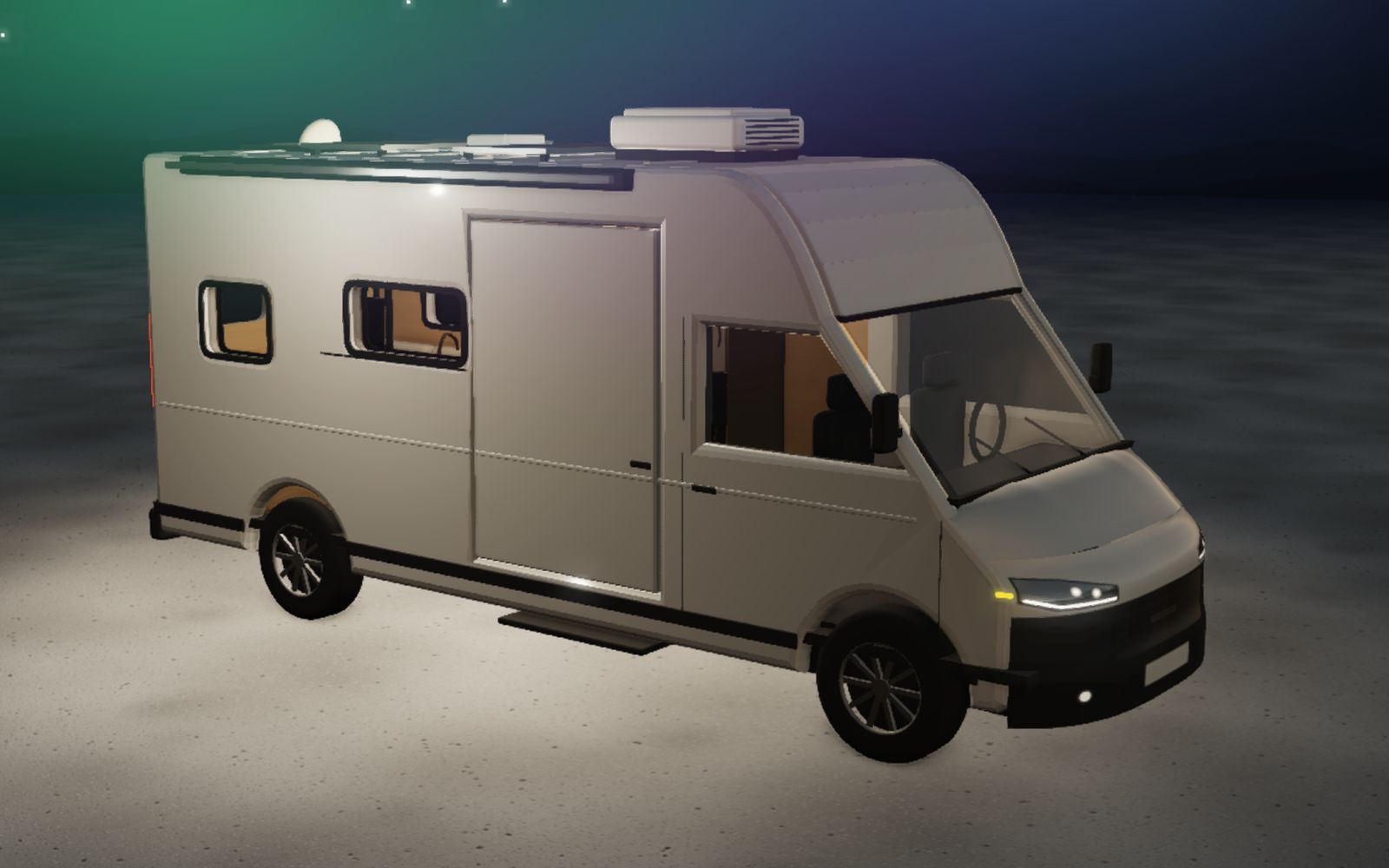
A metal van loses heat in three ways: through walls, roof and floor, through windows and cab, and through air exchange. Insulation slows the first, good covers the second. The third you must not cut out, or the van gets damp.
Where a van loses its heat
The biggest losses usually come from glass and the cab rather than the insulated walls, followed by thermal bridges through ribs and pillars, the floor and gaps around the doors.
- Cab: Insulated window covers and a thick curtain between cab and living area do a lot for little money.
- Windows: Double-glazed habitation windows with blinds beat single glazing by far. Every extra window is a cold surface in winter.
- Floor: An uninsulated floor means cold feet, even when the air is warm. Even 10 to 20 mm of rigid board under the floor covering helps noticeably.
- Ribs and pillars: Cover the metal sections too, or they form cold strips where moisture condenses.
Insulation materials compared
Thermal conductivity λ (lambda) tells you how well a material insulates: the lower the value, the better. The figures below are rules of thumb; what counts is the data sheet of the actual product you buy.
| Material | λ in W/(m·K), rule of thumb | Pros | Cons |
|---|---|---|---|
| Closed-cell elastomeric foam | 0.033–0.040 | Vapour-tight, flexible, bonds straight to the metal, follows curves | More expensive, heavier than rigid foam, apply the adhesive only with good ventilation |
| XPS rigid foam board | 0.030–0.038 | Unaffected by moisture, takes load, ideal for the floor | Stiff, poor fit on curved panels, joints must be sealed |
| Foil-faced PIR board | 0.022–0.028 | Excellent insulation per centimetre, good for roof and flat walls | Stiff, joints need careful taping, cutting is dusty |
| Sheep's wool | 0.035–0.045 | Absorbs and releases moisture, fills cavities, pleasant to handle | Not vapour-tight, needs ventilation and careful workmanship |
| Cork | 0.040–0.050 | Natural, unaffected by moisture, dampens noise | Less insulation per centimetre, heavier |
| Mineral wool and glass wool | 0.032–0.040 | Cheap | Soaks up water, slumps with vibration, fibres: not recommended in a vehicle |
A combination works well in practice: a continuous layer of elastomeric foam bonded to the metal of walls, roof and doors, cavities filled on top, and load-bearing boards in the floor. Thin foil-faced foam sheets barely insulate; the foil only reflects heat with an air gap in front of it.
Condensation and vapour barriers: the logic
Warm air holds more water vapour than cold air. In a van the vapour comes from breathing, cooking, wet jackets and showering. When moist air meets a surface colder than its dew point, water condenses: visibly on the windows, invisibly behind the panels, where it leads to rust and mould over time.
Three rules follow from this:
- Keep moist air away from cold metal. Either bond a vapour-tight insulation to the metal across the whole surface with no air gap and tape every joint, or fit a continuous vapour barrier on the warm, inner side.
- Whatever gets trapped barely dries out. Work in dry weather, use only dry materials and fill cavities with materials that don't hold water or, like sheep's wool, buffer it without damage.
- Ventilation is not optional. No insulation replaces air exchange. A roof fan or a slightly open hatch plus a gap at a window carries moisture out, even with the heater running.
Heating options compared
Which heater suits you depends on how often and where you stop in winter. As a rule of thumb, around 2 kW of heat output is enough for most panel vans; large vehicles, lightly insulated builds or trips into hard frost are better served by 3 to 4 kW.
| Heater | Pros | Cons | Best for |
|---|---|---|---|
| Diesel air heater | Runs off the vehicle tank, no extra fuel to carry, dry heat, compact | Needs power for the fan and start-up, the fuel pump ticks audibly, some units need adjusting at high altitude | Most vans, year-round travellers |
| Combi heater with hot water (diesel or gas) | Heating and hot water from one unit | More expensive and complex, takes more space, the boiler needs frost protection | Long vans with a washroom, winter trips lasting weeks |
| Propane gas heater | Quiet, independent of the vehicle tank, even heat | Gas system needs regular inspection, cylinders to swap or refill, butane barely vaporises below about 0 °C | Anyone already cooking on gas |
| 230 V electric heater | Cheap, quiet, no exhaust | Only makes sense on hook-up, drains a battery very quickly | Campsites with electricity, as a back-up |
| 12 V heated blanket | Keeps you warm in bed on very little power | Doesn't heat the space | An extra for cold nights |
For comparison: a 2 kW electric heater would drain a 200 Ah lithium battery (around 2.5 kWh) in just over an hour. A 2 kW diesel air heater burns roughly 0.1 to 0.25 litres of diesel an hour depending on the setting, plus a little electricity for the fan and pump.
Water, battery and solar in winter
- Fresh water: Tank and pipes belong inside the heated area. Pipes under the floor or along outside walls freeze first. If you leave the van without heating, drain everything.
- Grey water: A tank under the vehicle freezes in a prolonged cold spell. Either fit it inside, insulated and heated, or use a container inside the van over the winter.
- Lithium battery: Most lithium iron phosphate batteries must not be charged below 0 °C. Put the battery in the heated area or choose one with built-in heating and low-temperature protection.
- Solar: In the far north, panels deliver very little in winter: the days are short and the sun stays low. Then the DC-DC charger while driving or hook-up does the charging.
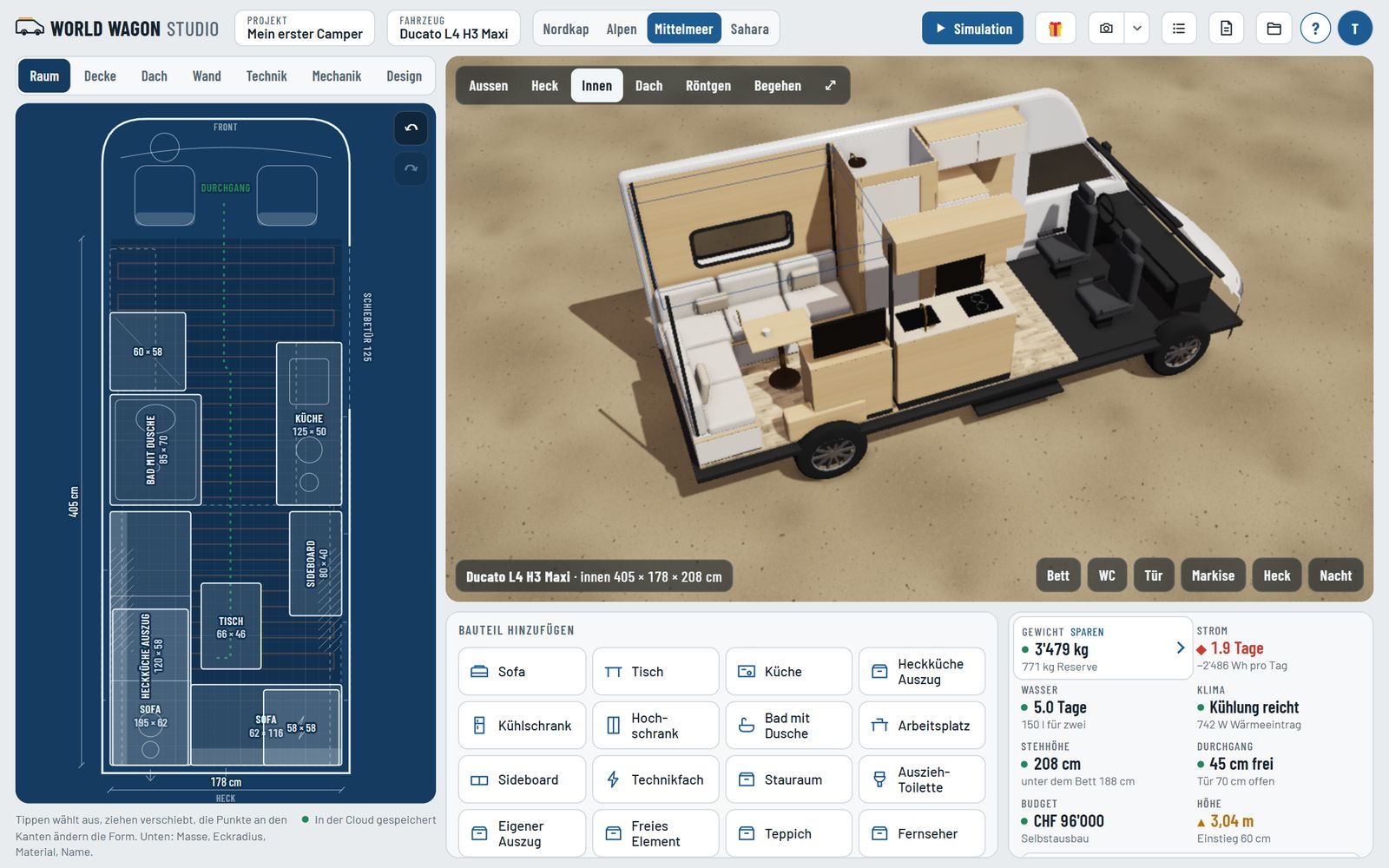
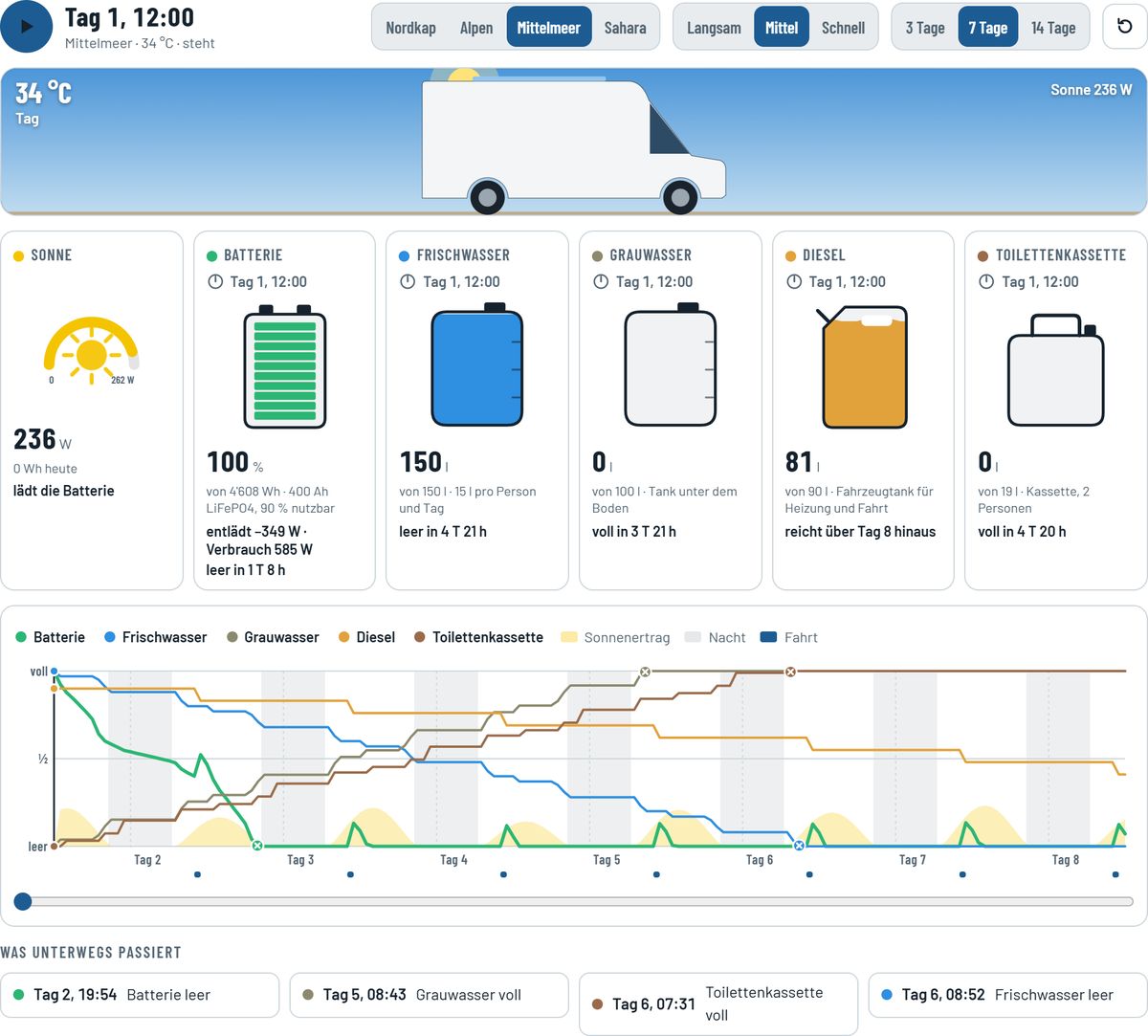
How long battery, water and diesel last depends on temperature, insulation and how you use the van. In the studio you can simulate it hour by hour over 3, 7 or 14 days, for example at the North Cape at −15 °C, where insulation and heating make the difference. For sizing, see the campervan electrical system and campervan water system guides.
Typical mistakes and a checklist for your first winter trip
These mistakes come up again and again in winter builds:
- Mineral wool or open-cell foam that holds water
- An air gap between insulation and metal, where condensation collects
- Cab not separated off, windows left uncovered
- Vents taped shut because of the draught
- Warm air outlet in a locker instead of low down in the living area
- Heater not professionally installed, exhaust close to the sliding door or a window
- Battery or water pipes in an unheated area
Checklist before you set off:
- Carbon monoxide and smoke alarms tested
- Heater serviced and tested overnight close to home
- Insulated covers and curtain for the cab packed
- Propane rather than butane if you cook or heat with gas
- Diesel suitable for low temperatures in the tank; in the far north, fill up locally
- Water system can be drained completely
- Ventilation open, even when it is cold outside
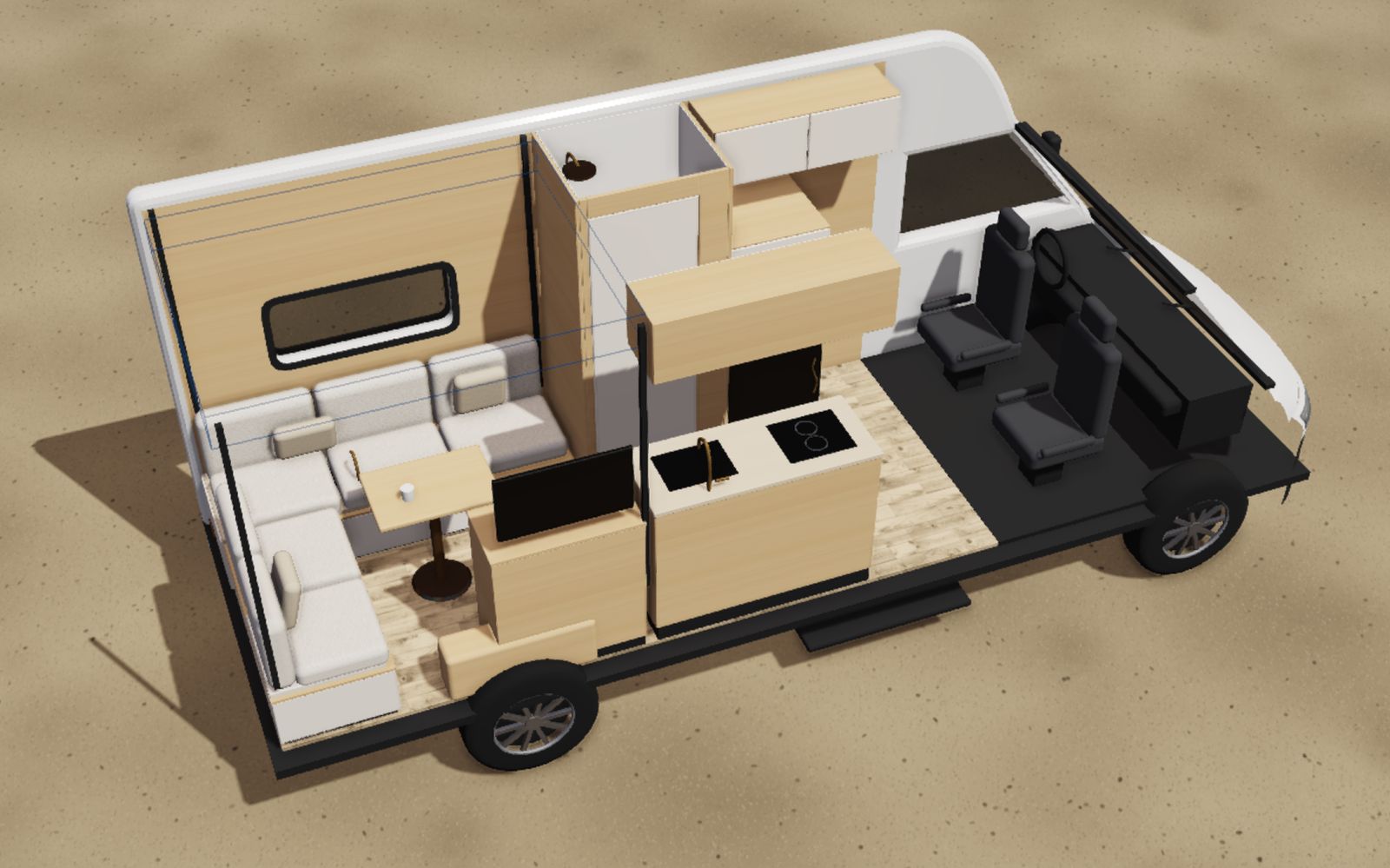
And at the planning stage: where the heater sits and where the warm air goes belongs in the layout, not in the weeks after the furniture is built.
Frequently asked questions
What is the best insulation for a campervan?
There is no single best material. A proven combination is closed-cell elastomeric foam bonded to the metal, load-bearing boards in the floor and sheep's wool in cavities; mineral and glass wool are not suitable in a vehicle.
Do I need a vapour barrier in a van?
If vapour-tight elastomeric foam is bonded across the whole surface with taped joints, it does that job itself. With vapour-open materials such as sheep's wool you need a continuous vapour barrier on the warm side, and you need to ventilate in any case.
How much diesel does a night heater use?
As a rule of thumb, a 2 kW diesel air heater uses roughly 0.1 to 0.25 litres an hour. Over a ten-hour night that is about 1 to 2.5 litres, depending on the cold and your insulation.
Can I heat my campervan from the leisure battery?
Hardly. A 2 kW electric heater empties a 200 Ah lithium battery in just over an hour; electric heating only makes sense on hook-up, while a 12 V heated blanket is an economical extra in bed.
Is it safe to sleep with a diesel heater running?
With a professionally installed heater, exhaust and combustion air routed outside, regular servicing and a working carbon monoxide alarm, it is common practice. Never heat with a cooker or an open flame, though.